Companies House Fraud Protection: Complete Guide for UK Businesses

Companies House fraud protection has become critical as fraudsters increasingly target UK businesses with sophisticated scams. With digital identity verification launching, cybercriminals are developing advanced methods to circumvent protective measures. This comprehensive guide provides essential fraud prevention strategies, helping you identify deceptive communications and implement robust compliance measures to protect your business integrity.
Jump to ↓
- How to Recognise Fraudulent Companies House Emails
- Red Flags in Deceptive Communications
- Response Protocol for Suspicious Communications
- Known Fraudulent Email Domains
- Identifying Fraudulent Postal Communications
- Response Protocol for Suspicious Letters
- Examples of known email scams
- Enhanced Protection with Thomson Reuters
- Stay Current on Emerging Threats
How to Recognise Fraudulent Companies House Emails
Remember: All legitimate government emails end in .gov.uk
- /gov.uk
- -gov.uk
- uk
Red Flags in Deceptive Communications
Fraudulent emails typically contain:
- False and confusing information
- Spelling or grammatical errors
- Pressure to act immediately
- Unexpected payment demands
- Copied formatting and logos mimicking Companies House branding
- Pressure to open attachments, click links, or provide authentication codes
Even if an email appears legitimate:
- Verify the sender – Authentic Companies House emails originate from addresses ending “.gov.uk”
- Examine links carefully – Hover over links to reveal their true destination; avoid clicking if the URL appears suspicious
Response Protocol for Suspicious Communications
If you receive a questionable email:
- Report immediately to: phishing@companieshouse.gov.uk
- Do not reply to the email and do not share personal information
- Do not open links or attachments.
- Delete the email completely, including from deleted items and notify your IT department
Known Fraudulent Email Domains
These domains have been identified in fraudulent communications claiming Companies House authority:
Fraudulent Domain:
| @arccoz.com |
| @companies-house-gov.uk |
| @companies-house.me.uk |
| @companieshouse.me.uk |
| @companieshousecomplaint.co.uk |
| @companieshousecomplaints.co.uk |
| @companieshouseemail.co.uk |
| @companieshouseemail.uk |
| @companieshousel.ink |
| @companieshouses.co.uk |
| @companieshouses.com |
| @companieshousesecure.co.uk |
| @companiesshouse.co.uk |
| @companiesshouse.com |
| @cp-securemessage.co.uk |
| @cpgov.uk |
| @ebilling-companieshouse-gov.uk |
| @libero.it |
| @notification.service.gov.uk.en-uk.website |
Identifying Fraudulent Postal Communications
Scam letters often feature:
- Poor print quality and formatting inconsistencies
- Suspicious web page links
- Counterfeit Companies House formatting and logos
- Unexpected payment requests or web page visits
- Urgent action demands which attempt to pressurise you
- QR codes linking to malicious sites
- Unauthorised bank details
Response Protocol for Suspicious Letters
Upon receiving a questionable letter:
- Contact Companies House immediately: 0303 1234 500
- Do not remit any payments to the sender
- Avoid visiting linked web pages or scanning QR codes
- Never share personal information
Examples of known email scams
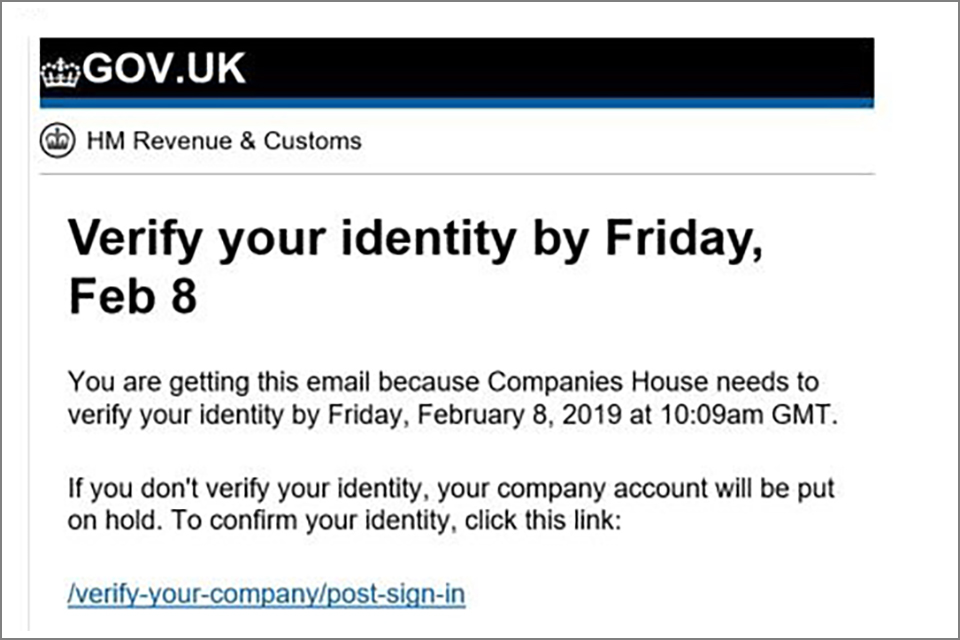
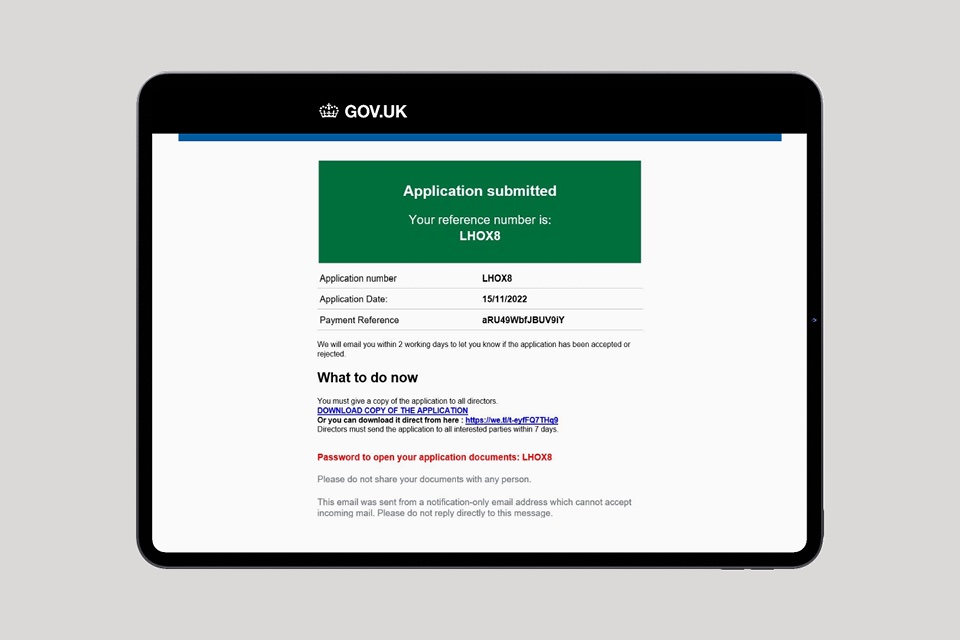
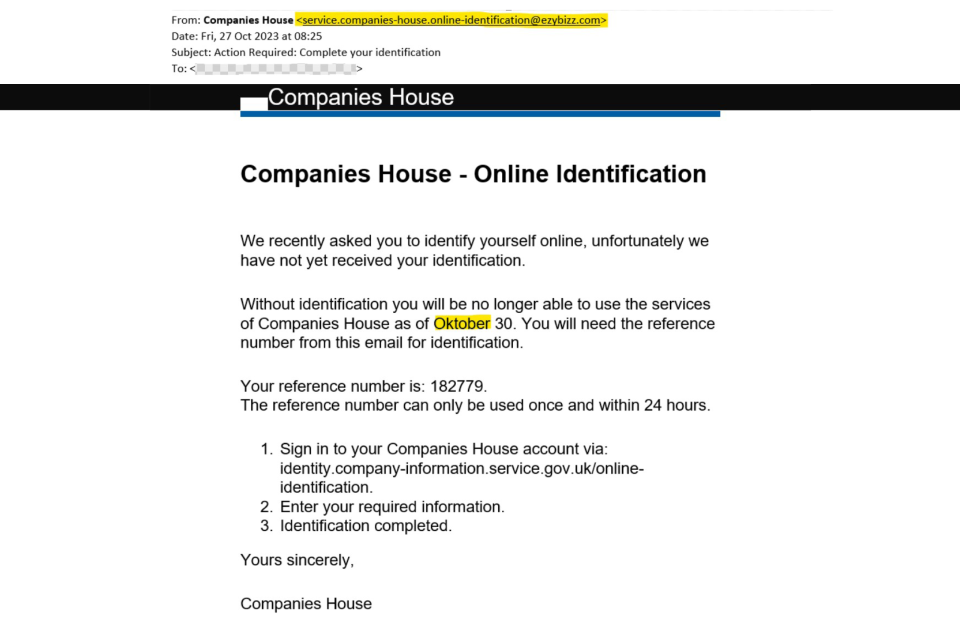
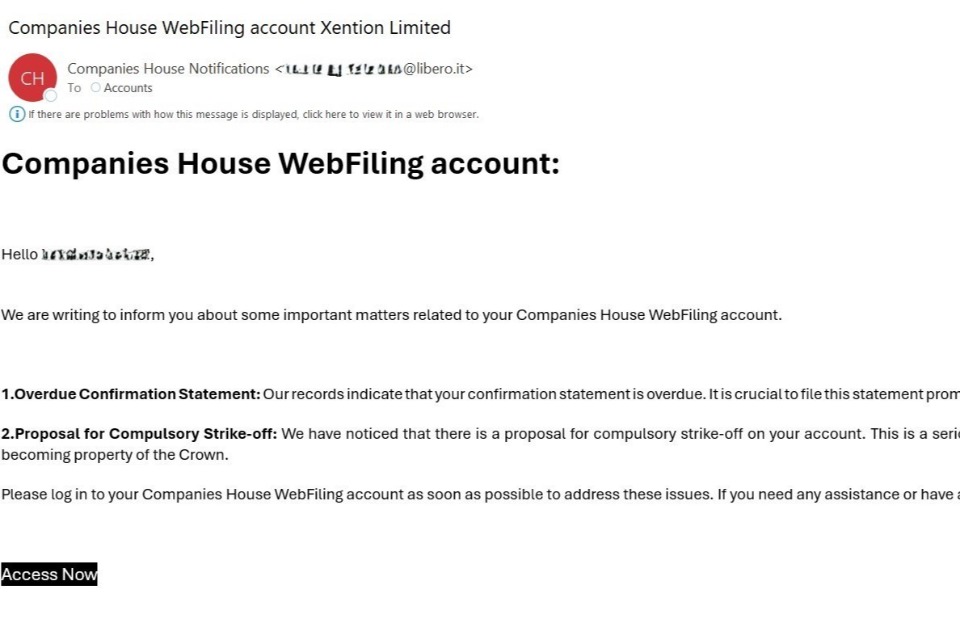
Companies House has documented specific fraud patterns and real-world examples targeting UK businesses. These sophisticated scams exploit trusted government branding through urgency tactics, fake identity verification demands, and deceptive communications designed to harvest sensitive business information or extract fraudulent payments from unsuspecting UK companies:
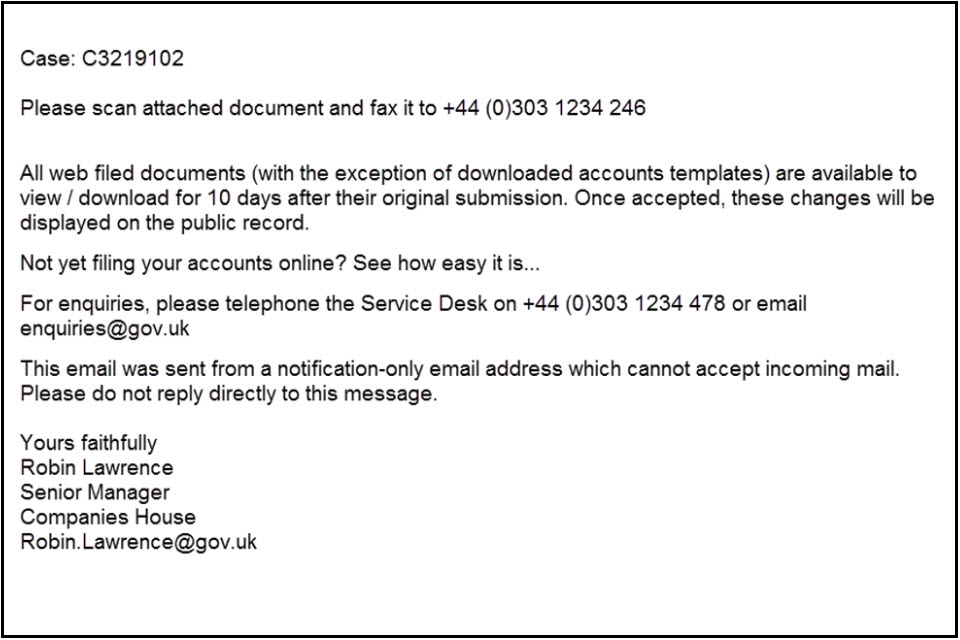
- Email from “Robin Lawrence” asking you to scan the attached document and fax it to +44 (0)303 1234 246:
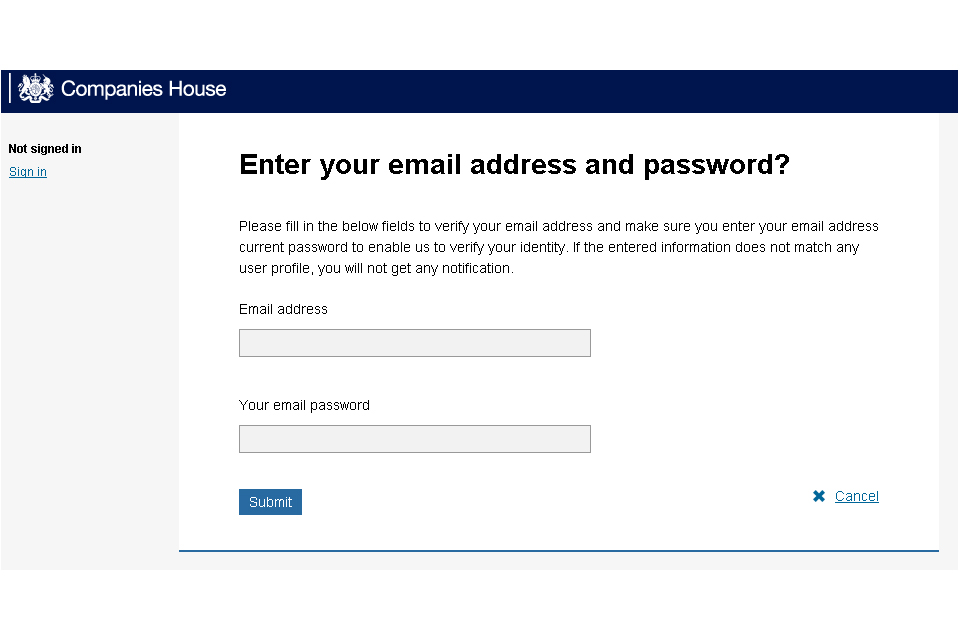
Scam email example: email from “Robin Lawrence”(JPEG, 91.7 KB) - Fake request to verify your email address:
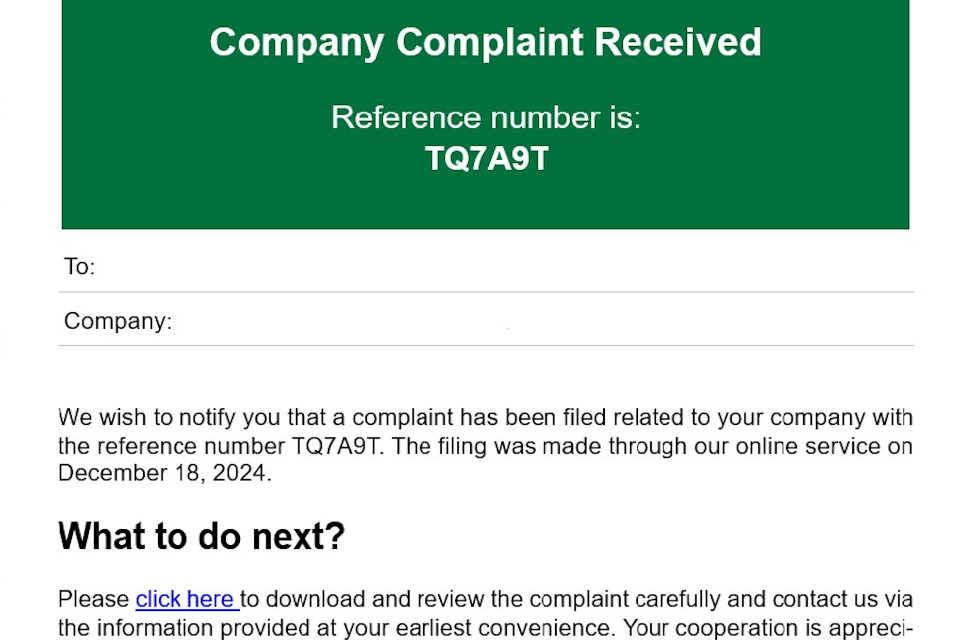
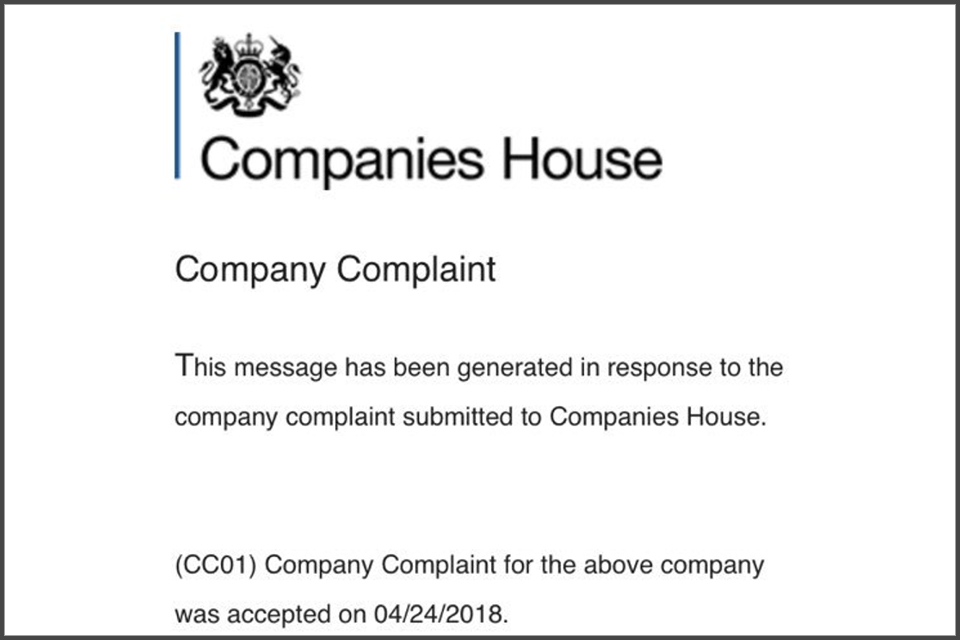
Scam email example: fake request to verify your email address(JPEG, 156 KB) - Emails claiming to be generated in response to a company complaint:
Scam email example: response to company complaint 1(PNG, 236 KB)
Scam email example: response to company complaint 2 (JPEG, 146 KB) - Email featuring the HMRC logo telling you that Companies House needs to verify your identity:
Scam email example: Companies House needs to verify your identity(JPEG, 169 KB) - Email telling you your “application” has been submitted and asking you to download a copy of the application:
Scam email example: your “application” has been submitted(JPEG, 70 KB) - Email asking you to “verify your identity” within 24 hours using a one-time “reference number”:
Scam email example: verify your identity within 24 hours(PNG, 144 KB) - Email claiming to “inform you about some important matters related to your Companies House WebFiling account” with a button saying “Access Now”:
Scam email example: important matters related to your Companies House WebFiling account(JPEG, 73.9 KB) - Request to complete a “Know Your Customer (KYC) and Know Your Business (KYB) verification”:
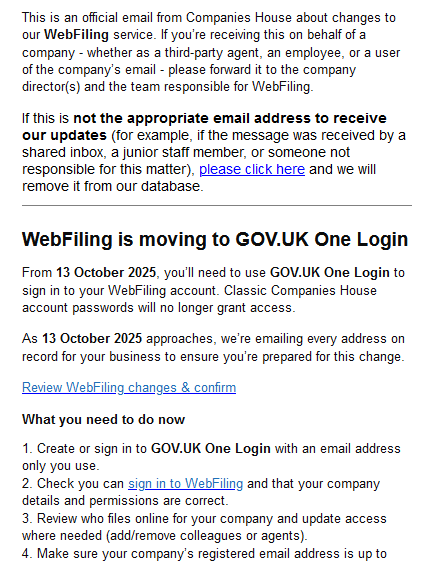
Scam email example: “Know Your Customer” and “Know Your Business”(PDF, 125 KB, 2 pages) - Email claiming to be about “changes to our WebFiling service”:
Scam email example: “changes to our WebFiling service”(PNG, 49.9 KB)
Enhanced Protection with Thomson Reuters
If you want a practical way to embed onboarding, screening, and continuous monitoring without adding headcount, explore Digita AML: AI-powered anti-money laundering for accountants and how its integration with Red Flag Alert can support an audit ready approach to anti money laundering compliance across your client base. Our team can help you map your current processes to the expectations in the government consultation and plan for FCA supervision. Our Digita AML solution, partnered with Red Flag Alert, includes advanced fraud protection features that complement your vigilance:
- 24/7 Real-time Monitoring: Unlike the competition, our platform provides perpetual monitoring with immediate MLRO notification and a complete audit trail
- Advanced Ownership Detection: We expose beneficial ownership down to 0.01%, far below the 25% industry standard – revealing hidden stakeholders, minority shareholders, and complex corporate structures that competitors completely miss
- Defence-grade Compliance Rigor: Our AI technology detects sophisticated fraud, forged documents, and deepfakes with advanced protection that basic verification tools miss
- Multi-dimensional Risk Intelligence: Our Business Intelligence Engine generates up to 100 monitor alerts per client entry, identifying risks that competitors’ basic alert systems completely miss
- Regulatory-ready Documentation: When regulators ask “prove you’ve conducted ongoing monitoring,” our customers can defend their position instantly—unlike many competitors, which require manual compilation from scattered spreadsheets, emails, and separate platforms
Stay Current on Emerging Threats
For the latest fraud alerts and protective guidance, visit: https://www.gov.uk/guidance/reporting-scams-pretending-to-be-from-companies-house
Remember: When digital identity verification becomes the norm, fraudsters adapt their methods. Your awareness and our technology work together to protect your business integrity.
Fraud patterns and examples adapted from UK Government guidance available at gov.uk under Open Government Licence v3.0
Visit our events page for upcoming and on demand AML webinars to support your compliance journey.
To find out more about how the Digita Professional Suite could help you optimise your operations, contact us.
 |